

Webinar on Export Training Program for Entrepreneurs, Start-Ups & MSMEs — From Beginner to Global Exporter · Virtual (Video Conference) · 4th May – 14th May 2026.
Ten days. A structured dismantling of every assumption I had about what it takes to run an export business properly.
FIEO Karnataka Chapter put together this certificate program with speakers from DGFT, Customs, ECGC, banks, SGS, IIP, India Post, and the trade logistics world. The ICP for the room was mixed — first-timers, MSMEs, and a few seasoned exporters. What worked regardless of where you stood was the sequencing. Each session built on the last. By day ten, you had a mental map of the full export cycle, end to end.
Here's the gist.
Day 1 — Finding Global Buyers and Entering the Right Markets
4th May 2026 · Mr. Sivaraman S, Advocate & Foreign Trade Advisor. Initiated by Mrs. Soma Chaudhury, Joint Director & Karnataka Head, FIEO.
The opening session flipped the conventional approach. Rather than starting with a product and hunting for buyers, the session made the case for using data to understand where demand already exists — then aligning your supply accordingly.
The two core tools demonstrated live:
- Commerce.gov.in — the government's trade data portal. Export and import data by HS code, country, and commodity. The live demo pulled which 111 countries were importing a specific product from India, sorted by value and growth rate. The insight: if you're starting out, target markets with good growth rate rather than chasing the dominant ones where competition is entrenched.
- Trademap.org — the ITC's market intelligence platform. The Export Potential Map does the analysis for you: for a given HS code, here are the markets where Indian exporters are most competitive, the realised export value, and the untapped potential.
Before starting Adalwin Global, we ran our own exercise — analysing 874 products using trade data before narrowing down to cotton textile products: bathrobes, terry towels, bath mats, and bed linen. The program then gave that decision a sharper framework.
The PEST framework came into the conversation for country validation — political stability, economic conditions, socio-cultural dynamics, and technology penetration. And one underused reference: ECGC's quarterly country risk classification circular, which rates 187 countries from A1 (insignificant risk) to D (very high risk), updated every quarter and available on ecgc.in.
For buyer identification, the methods ranged from Google keyword search (product + seller/distributor/manufacturer + city name + country name), Google Maps, yellow pages directories country-wise, Europages for European buyers, Compass.com for B2B, and trade inquiries routed through Indian embassies via FIEO's Indian Trade Portal. The session was outreach through cold email, WhatsApp, LinkedIn, and landline calls to Google Maps-listed businesses, which are generating better traction.
Day 2 — FIEO Services, Indian Trade Portal & Indian Business Portal
5th May 2026 · Mrs. Soma Chaudhury & Mrs. Danisha Minu, Deputy Director, FIEO. Mr. Mohammed Adnan, Director – SME eCommerce Growth, GlobalLinker.
The Indian Trade Portal (maintained by FIEO on behalf of the Ministry of Commerce) gives exporters access to:
- HS code-level export/import data, SPS/TBT measures by country.
- Duty drawback rates, RoDTEP, GST information.
- Trade and tender inquiries from overseas buyers routed through Indian embassies.
- Global tender services — multilateral and foreign government procurement bids.
The Indian Business Portal (co-created with GlobalLinker) is a parallel marketplace where exporters list products, receive RFQs from international buyers, and create a structured B2B profile. Listing is free. The session made an important point about discoverability: buyers are increasingly running supplier evaluations through AI tools before making contact. If your company's digital footprint isn't structured for machine interpretation, you risk invisible deselection — being filtered out before you're even aware of an inquiry.
Day 3 — Government Support for Exporters: DGFT & ECGC
6th May 2026 · Mr. Dharmateja G P, Young Professional, O/o Additional DGFT, Bangalore. Mr. Gaurav Tewari, AGM & Branch Manager, ECGC Bangalore.
DGFT session
The IEC is now PAN-linked and system-generated, with mandatory annual validation April to June — deactivation follows if missed. Key schemes covered:
- Advanced Authorisation (AA) — duty-free import of raw materials for manufacturing export goods. Export obligation: 18 months. Minimum value addition: 15%. Application fees are significantly reduced for MSMEs.
- EPCG — import capital goods at zero duty. Export obligation: six times the duty saved over six years. First 50% in four years, balance in the remaining two.
- Certificate of Origin — preferential (under FTAs) vs. non-preferential. With India's recent trade agreements — ECTA with UK, CEPA with UAE, ECTA with Australia, and now New Zealand — knowing which products enjoy preferential rates where is a pricing and market selection input.
ECGC session
Three risk categories and what covers each:
- Loss or damage in transit → Marine Insurance.
- Exchange rate volatility → Hedging via Authorised Dealers.
- Buyer default / non-payment → ECGC Credit Insurance — the most underused of the three.
ECGC's coverage isn't just for exporters. It runs parallel tracks — covering exporters against credit risk losses and banks against non-payment by exporters. This dual structure de-risks the full transaction chain and directly influences a lender's appetite to finance export transactions.
The buyer underwriting scorecard goes through business ability (ownership structure, legal obligations, agency ratings), financial strength (working capital, retained earnings, net worth, total debt), and transaction behaviour (buyer's history with ECGC, with the exporter, and the exporter's own track record with ECGC).
Country risk uses a multi-factor model:
- Economic risk — 10+ macroeconomic factors per country.
- Political risk — quantitative and qualitative governance data.
- Bilateral trade relations — India's eco-political standing with that country.
- ECGC claims history + Berne Union inputs + forward-looking forecasting — treated as distinct pillars.
The closing point from Mr. Gaurav Tewari: the policy doesn't just protect receivables. It strengthens your negotiating position with buyers (offer credit terms with confidence) and your credit profile with banks (PSU banks weight ECGC cover when assessing financing appetite).
Day 4 — SGS India: Export Inspection & Export Packaging
7th May 2026 · Ms. Medha Singh, Mr. Sandeep Patankar (PCA), Ms. Vrushali Raghuvir (BIS), SGS India Pvt. Ltd. Mr. Harish Kumar, Technical Officer, Indian Institute of Packaging, Bangalore.
SGS session
PVOC — Pre-export Verification of Conformity — is a government mandate from importing countries, particularly in Africa and the Middle East. Your product gets inspected and tested by an authorised body before it leaves India. Certificate of Conformity issued. Without it, delays or rejection at destination.
Key points:
- Standards hierarchy: national standards first, then regional, then international. If none exist — manufacturer specifications.
- Testing validity: 6 months for most food products, up to 5 years for electrical/mechanical items. Traceability matters — test the batch you're shipping, not a different one.
- Shelf life requirements vary by destination. Many countries require at minimum 75% of shelf life remaining on arrival.
- Labelling — mandatory fields vary by country: language of the importing country, country of origin, production/expiry dates, storage instructions. Missing any of these grounds for rejection.
BIS certification: ISI marking for Scheme 1 products (electrical, electronics, building materials, medical equipment, toys, furniture), CRS marking for IT goods. Foreign manufacturers exporting to India must go through the Foreign Manufacturing Certification Scheme (FMCS) — physical audit and lab-tested samples via BIS-approved labs.
IIP session
Primary, secondary, and tertiary packaging serve different functions — protection, grouping, and transportation. No single package fits all three.
Critical distinctions:
- Domestic packaging standards and export packaging requirements are different. Don't use the same material for both markets.
- Regulatory frameworks vary: FSSAI for food in India, EU standards for Europe, GCC for the Gulf, FDA for the US.
- ISPM15 marking — mandatory for wooden pallets and containers. Fumigation certificate required.
- Over-packaging wastes cost; under-packaging fails the product. The balance is determined by product characteristics, transport mode, and destination requirements.
Day 5 — Export Documentation, Pricing & Logistics
Mr. Girish Narayan, Hon. Secretary, Bangalore Custom House Agents Association Ltd.
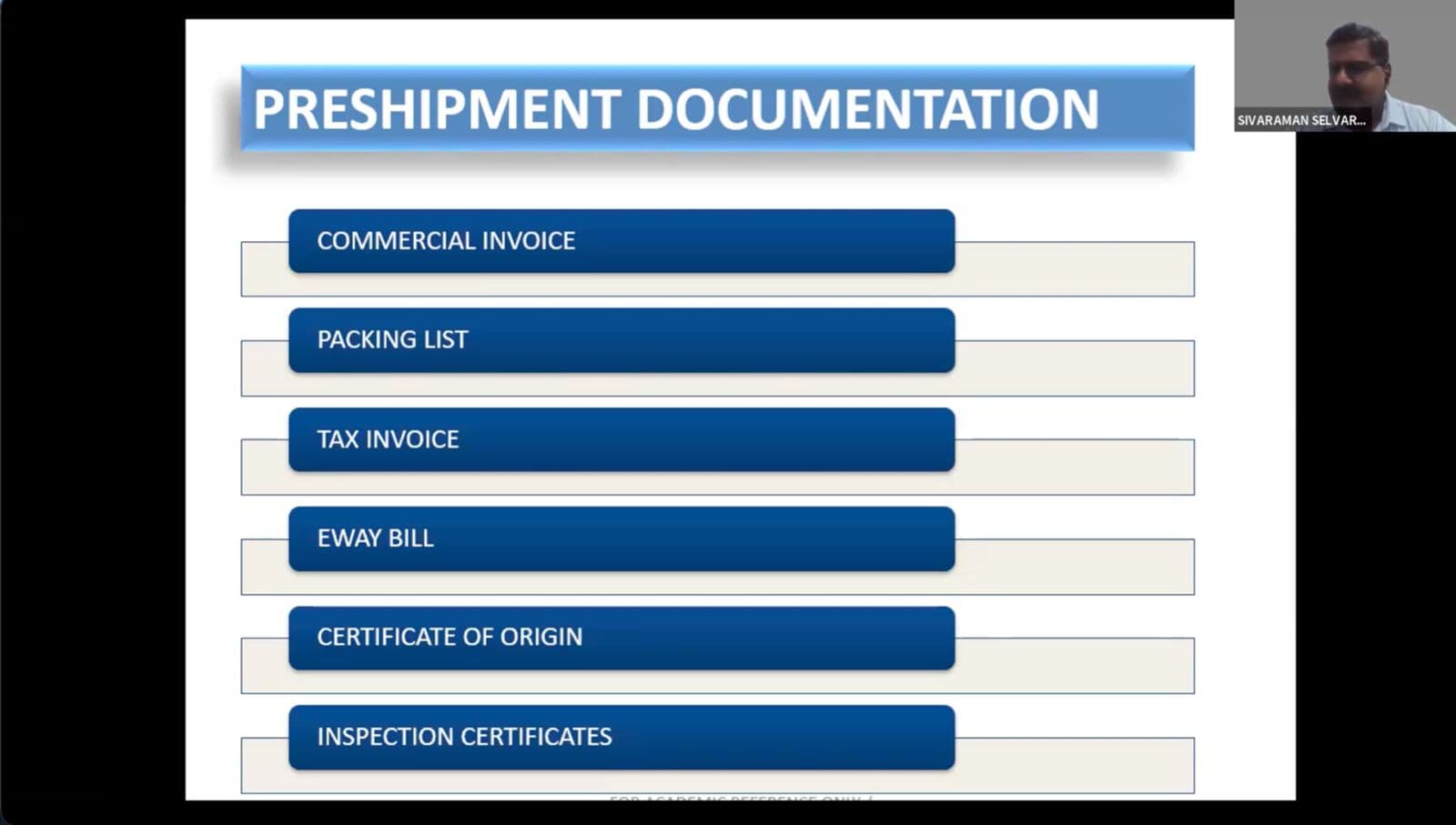
Pre-shipment documentation serves three purposes: customs clearance, transportation arrangement, and obtaining certificates (certificate of origin, inspection certificates). Post-shipment documentation serves one: payment realisation.
The documents that matter:
- Commercial Invoice — value declaration, product description, HS code, buyer/seller details, payment terms, incoterms, port details.
- Packing list — box-by-box breakdown: marks, net weight, gross weight, dimensions, content. This is what customs officers use when they want to examine specific goods without opening every carton.
- Shipping bill — customs clearance document, issued via ICEGATE. Proof of legal export.
- Bill of Lading / Airway Bill — transport proof and title document. Original BL required for goods release at destination.
- Certificate of Origin — non-preferential (origin proof) vs. preferential (FTA duty benefit).
On pricing: the full cost structure includes manufacturing cost, carriage, freight, insurance, customs duties at the other end, agent commissions, bank charges, interest on export finance, and expected drawback/RoDTEP receipts. Domestic selling price is not a base for export pricing — they are structurally different.
Day 6 — Managing GST in Exports
9th May 2026 · Mr. Jatin Sanghvi, Chartered Accountant, JSA.
The four key benefits for exporters under GST:
- No output tax on exports.
- Input tax credit available even without output tax liability.
- ITC available even for inputs used in exempt domestic supply, if those inputs are used for export.
- Unutilised ITC refundable — apply via RFD-01.
Two invoice options for export:
- LUT (Letter of Undertaking) — invoice without payment of IGST. Free to generate on the GST portal, valid for the full financial year. No cash flow impact.
- IGST paid method — pay IGST on export invoice, get automatic refund once customs reconciles EGM and shipping bill with GST data. Useful when capital goods ITC is blocking a refund under LUT.
Merchant exporter scheme: procure from manufacturers at 0.1% GST (instead of 5/12/18/28%), export under LUT, then provide shipping bill and EGM copy to the supplier. If proof isn't submitted, the supplier faces liability for the differential — making this a trust-based arrangement with documentation discipline as the backbone.
Day 7 — Customs' Role in Facilitating International Trade
11th May 2026 · Mr. T Suresh Kumar, Superintendent, ICD, City Customs, Bangalore.
The trade facilitation infrastructure:
- ICEGATE — the central portal through which shipping bills, import documentation, duty payments, and IGST refund triggers flow. Integrated with GSTN, customs IT, and PFMS.
- RMS (Risk Management System) — decides whether a consignment gets facilitated (auto-release), assessed, or examined.
- AEO (Authorised Economic Operator) — three tiers. T1 requires 3 years in the international supply chain and 25 import/export documents in the last financial year. Benefits scale up: T1 gets 50% bank guarantee reduction, T2 gets 25%, T3 is exempt. DPD (Direct Port Delivery for imports) and DPE (Direct Port Entry for exports) available to T2 and T3.
- EMI (Eligible Manufacturer Importer) Scheme — new from 1st April 2026. Deferred import duty payment for eligible manufacturer-importers. Designed as a stepping stone toward AEO certification.
Export incentives: Duty Drawback (percentage of FOB value, credited as cash post-EGM), RoDTEP (embedded taxes not refunded under GST, paid as scripts), RoSCTL (textiles-specific), and IGST refund (automatic once shipping bill, GSTR1, GSTR3B, and EGM reconcile).
Days 8 & 9 — Export Finance, Incoterms, Payment Methods & Forex Risk
12th May 2026 · Ms. Tejashree Pawaskar, Chief Manager, Bank of Baroda, Bangalore (Pre-shipment & Post-Shipment Funding and Incoterms).
Payment methods — risk ladder:
- Advance payment → 100% risk on buyer. Exporter ships after receiving payment.
- Open account → 100% risk on exporter. Goods shipped, payment follows later.
- Documentary collection (DP/DA) → Bank as intermediary. DP: payment before document release. DA: buyer accepts a bill of exchange (promise to pay), gets documents, pays on maturity. Risk still sits with the exporter under DA — buyer can delay or default.
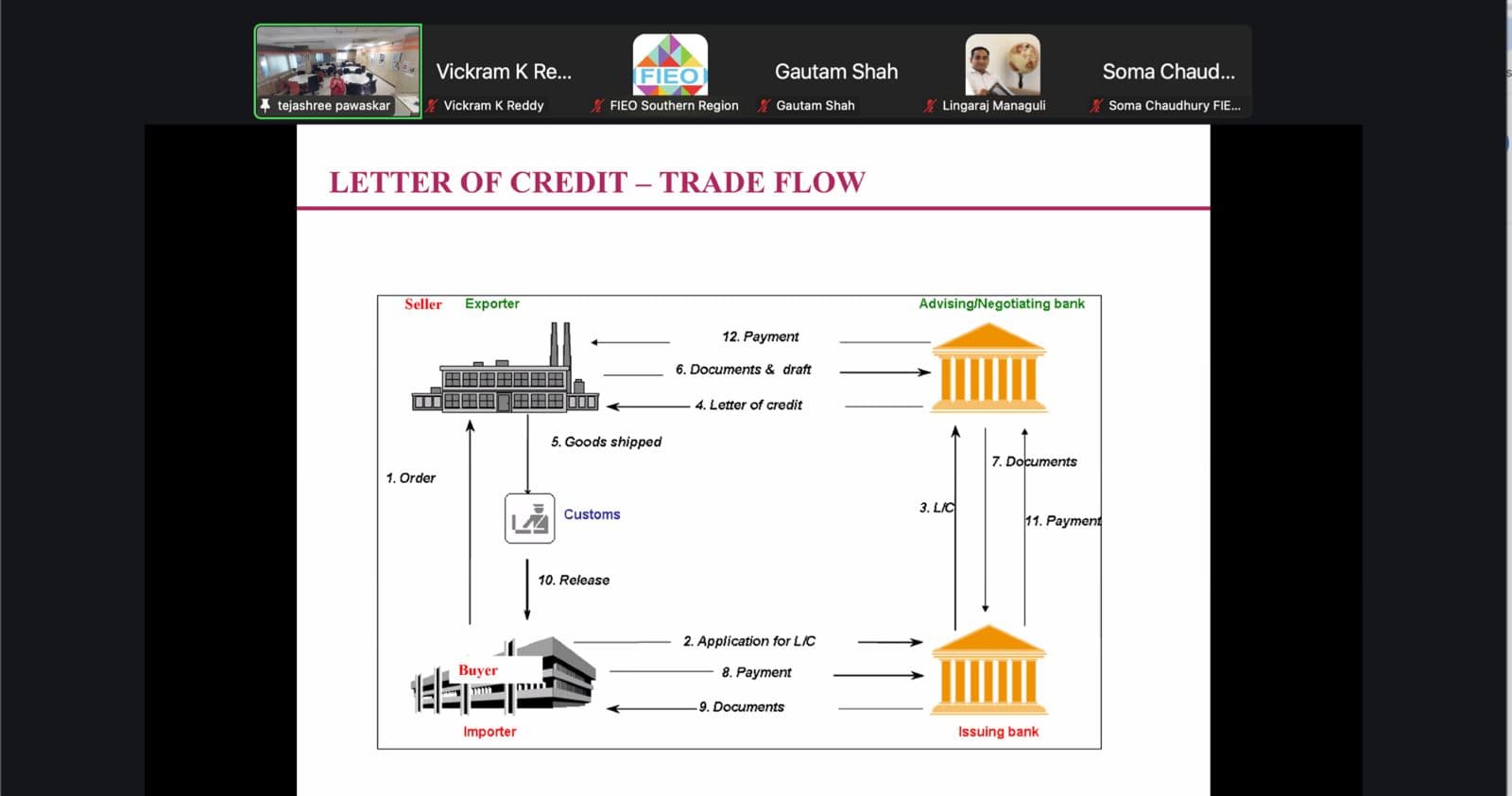
- Letter of Credit → Risk transferred to banks. Importer bank issues a written undertaking: compliant documents within the prescribed timeline = payment guaranteed. Even if the importer has zero funds on due date, the issuing bank pays. Confirmed LC adds a second guarantee from the advising/confirming bank — relevant when the issuing bank's country stability is uncertain.
Incoterms 2020 — eleven terms, two categories:
For any mode of transport
- EXW (Ex Works) → factory gate only; all costs and risk from there: buyer's.
- FCA (Free Carrier) → seller delivers to named carrier or place.
- CPT (Carriage Paid To) → seller arranges and pays carriage to destination.
- CIP (Carriage and Insurance Paid To) → carriage + insurance paid by seller.
- DAP (Delivered at Place) → seller delivers to named destination, not unloaded.
- DPU (Delivered at Place Unloaded) → seller delivers and unloads.
- DDP (Delivered Duty Paid) → seller bears all costs including import duties.
For sea and inland waterway only
- FAS (Free Alongside Ship) → goods placed alongside the vessel at origin port.
- FOB (Free on Board) → goods loaded on board; most commonly used in practice.
- CFR (Cost and Freight) → seller pays ocean freight to destination port.
- CIF (Cost, Insurance and Freight) → freight plus marine insurance paid by seller.
Hedging
India has been on a managed floating exchange rate since March 1993, following the economic liberalisation of 1991 and the introduction of LERMS in 1992. Since then, the rupee's value is market-determined, with RBI intervening to manage volatility — not to peg the rate.
Because the rate fluctuates, exporters face forex risk between the invoice date and payment receipt. Hedging mechanisms:
- Forward contracts — lock in an exchange rate today for a future transaction. Once booked, no volatility. The forward rate = spot rate + forward premium (differential between the repo rates of the two currencies).
- Natural hedge — matching dollar inflows (exports) with dollar outflows (imports) so currency fluctuation cancels out.
- Rupee invoicing — invoicing in INR eliminates forex exposure entirely. RBI is actively incentivising this through the SRVA (Special Rupee Vostro Account) framework as part of INR internationalisation.
- Leading and lagging — accelerating payment of a strengthening currency, delaying payment of a weakening one.
Interest subvention: 2.75% per annum for MSMEs on export credit (pre and post-shipment), reducing the effective financing rate significantly compared to commercial lending.
Day 9 (continued) — Dak Ghar Niryat Kendra: India Post's Export Channel
13th May 2026 · Mr. Venkateshiah, Assistant Director, Foreign Post Office, India Post.
This was new territory for most of the participants. India Post's export infrastructure — 1,200+ Dak Ghar Niryat Kendras across all districts, 100+ in Karnataka — offers two things private couriers don't: actual weight billing (not volumetric), and subsidised rates for small consignments.
A live example from the session: a 30 kg consignment to UAE — private courier quoted ₹25,000. India Post rate: ₹7,268.
The four product categories: EMS (up to 35 kg, 220 countries), Air Parcel (up to 20 kg, 219 countries), Registered Letter (documents and light goods, charged at actual weight from 50g), and ITPS (International Tracked Packet Service — 50% subsidised, useful for samples up to 2 kg and widely used for e-commerce exports).
Onboarding is free. Documents: Aadhaar, PAN, GSTN, AD code, IEC, bank account details, LUT. Self-booking portal with pickup from your premises. Customs clearance is done in-house at the Foreign Post Office — no separate CHA needed for DNK shipments. IGST refund, duty drawback, and EDPMS integration are all active.
Volume discounts kick in above ₹25,000/month in postage. BNPL (book now, pay later) available with a 3-month bank guarantee.
Day 10 — Export Order Processing: Step by Step
14th May 2026 · Mr. Sivaraman S, Advocate & Foreign Trade Advisor — and Valedictory Session.
The final session by Mr. Sivaraman brought the full cycle together — product selection to payment realisation — as a continuous, repeatable process.
The sequence:
- Product selection (existing business / experience / district availability / Export Potential Map).
- Country selection (Trade Map + ECGC rating + proximity + trade agreements).
- Buyer identification (network, keyword search, directories, Indian Trade Portal).
- Team building — supplier, transporter, CHA, consultant — before the first order arrives.
- Registrations and digital infrastructure (website, LinkedIn, professional email domain).
- Buyer approach and promotion.
- Inquiry → quotation → negotiation → proforma invoice → purchase order → ECGC cover → order acceptance.
- Production, in-process quality checks, pre-shipment inspection.
- Pre-shipment documentation and customs clearance.
- Post-shipment documentation → bank submission → payment realisation → packing credit liquidation.
The point he returned to: the export business is a cycle. Registration is one-time. Buyer-finding and order-processing repeat. The exporters who build systems around each stage — pre-verified logistics, a briefed customs broker, a supplier who understands your quality requirements — are the ones who execute without losing time when an order arrives.
What Ten Days Added Up To
I joined this program to upskill and stay on par with the new government schemes. The finance sessions with Ms. Tejashree Pawaskar were the highlight — the mechanics of pre and post-shipment credit, how interest subvention works in practice, and the strategic use of LC discounting for liquidity gave me a much clearer picture of how export finance integrates with the operational cycle. I also came away with new outreach channels I hadn't worked with before — the Indian Business Portal, the Dak Ghar Niryat Kendra for sample shipments, and the FIEO trade inquiry database.
If you're operating in international trade and haven't done a structured program recently, find the time. The ground shifts, and the specifics matter.
— Vickram, Adalwin Global