

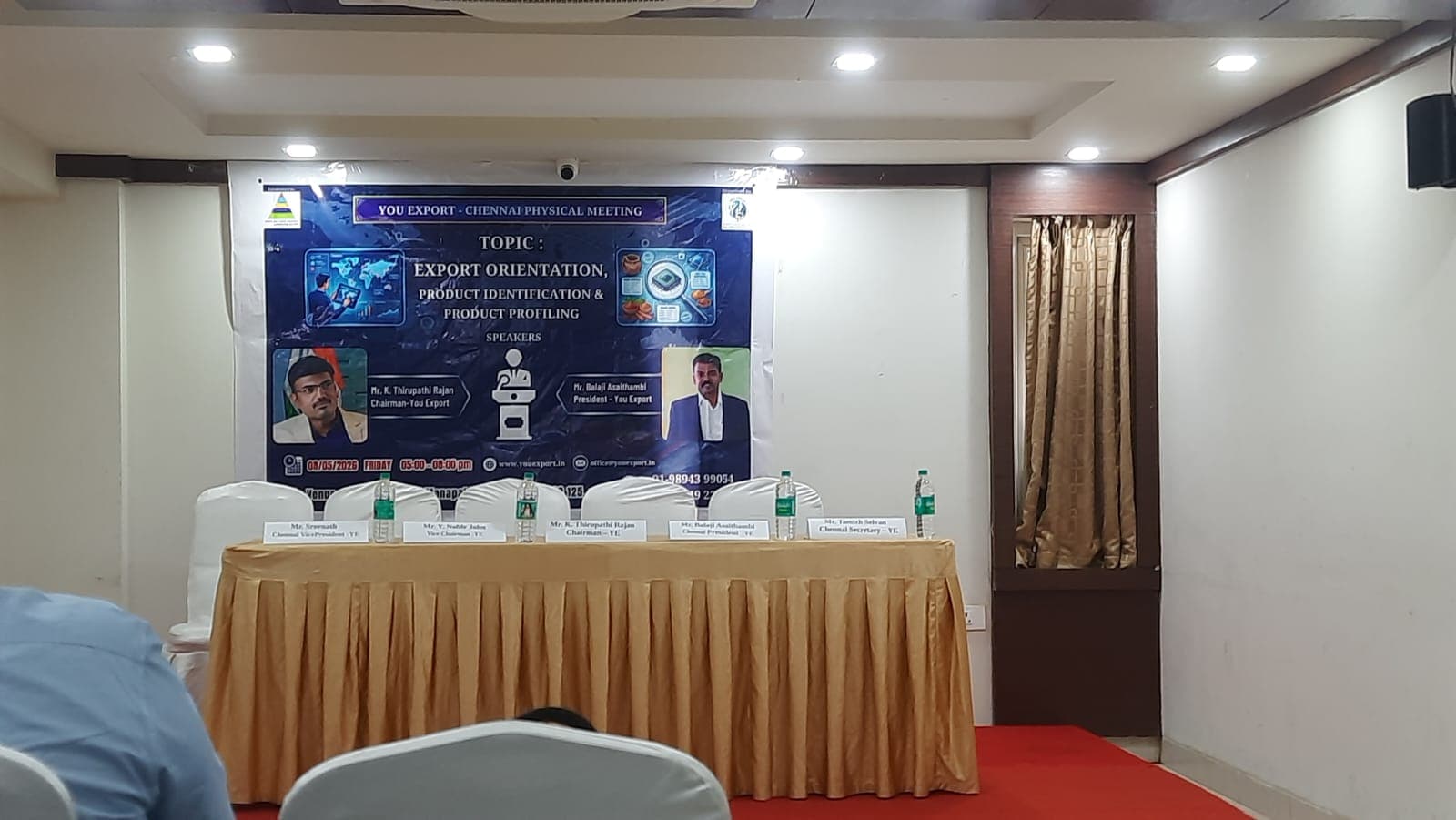
YouExport's Chennai physical meeting on Export Orientation, Product Identification and Product Profiling ran at Kuber Inn Elite, Manapakkam, on the evening of the 8th of May 2026 — a compact three-hour format, 5 to 8 PM, focused agenda, the right kind of crowd for the format. Adalwin Global attended.
This is a field note rather than a conference report. YouExport runs these as practitioner-led peer formats — not academic curriculum, not vendor-led pitches — and the value compresses in two places: the speakers, and the conversations between sessions. Both delivered. Writing it down while it is still fresh.
The room — who was on stage
Mr. K. Thirupathi Rajan, Founder and Managing Director of Raj Exim Group and Chairman of YouExport, opened the evening. He holds DGFT-recognised One Star Export House status — a recognition that requires a minimum FOB export performance of USD 3 million over the qualifying window, and which is the entry tier of India's Export House hierarchy. Beyond the title, the operational meaning is that he has already navigated the documentation, compliance and scaling questions every first-generation exporter in the room is sitting in front of right now.
Mr. Balaji Asaithambi, President of YouExport, runs Sanguine Logistics — the freight-forwarding firm he founded in 2006 — and is AEO-certified (Authorised Economic Operator, a Customs-side recognition issued by the Central Board of Indirect Taxes and Customs that grants streamlined clearance, lower inspection ratios, deferred-duty privileges and faster turnaround at Indian ports). For exporters whose container math is set by lead times and not by freight-rate cents alone, AEO-tier handling is operationally meaningful in a way that is rarely visible until something goes wrong at the port.
Session 01 — the Product Wheel, by Mr. Thirupathi Rajan
The standout from the evening was the Product Wheel analogy — a deceptively simple framework for how exporters should think about product selection. The image is a cycling wheel, and the framework asks exporters to be honest about whether every component is actually in place for the wheel to keep turning.
The wheel itself is the product. That means the right HS classification (because every cent of duty advantage and every certificate-of-origin claim hinges on the four-to-eight-digit code being correct), genuine market fit at the destination (no exporter wins by carrying a domestic-market SKU into a buyer geography that doesn't want it), realistic MOQ thresholds matched to the production unit's economics, and packaging standards built for the destination market — not for the exporter's own warehouse, not for the Indian retail floor.
The spokes are everything that holds the wheel together: category-relevant certifications (Oeko-Tex, GOTS, BIS, BSCI, Sedex SMETA, country-specific labelling regimes), compliance documentation that the buyer's procurement and legal teams will actually accept on first reading, and buyer-ready specifications — tech packs, tolerance sheets, shade cards, fitness tests — that pre-empt the questions a serious procurement team is going to ask in the qualifying call.
The brakes are ECGC and risk management. The framing was precise, and worth restating: brakes don't slow the wheel down — they let the rider push harder by providing a way to stop without crashing. ECGC short-term cover, country-risk classifications, buyer-credit underwriting scorecards — these are the instruments that let an exporter quote open-account or extended credit terms without putting the entire balance sheet on a single buyer's payment behaviour. Treating them as cost rather than capability is a common first-generation mistake.
Mr. Thirupathi Rajan was particular about three operating decisions that he framed as baseline rather than upgrade. A functional, buyer-credible website (not brochure-ware, not a portfolio site — a working presence procurement teams can actually use to qualify the supplier in the first three minutes of a search). Professional buyer communication — formal-register email, structured RFQ replies, on-time follow-through, language that does not need translation to land at a New York or Frankfurt desk. And the deliberate choice of value-added products over commodities, where the margin and the moat both come from the value-addition tier rather than from underbidding incumbents on raw spec.
His framing was not 'these are nice-to-haves'. His framing was: this is the lowest acceptable baseline for any exporter who intends to build something that lasts past the third buyer. The bar is unsentimental, and the people who clear it tend to be the people in the room ten years from now.
Running through the session was a disposition that does not always survive in industry-association formats: a genuine belief that teaching and sharing deepens one's own knowledge, applied — not declared. He answered every question as if his own learning was at stake in the answer. That orientation is its own form of credentialing. Had a useful conversation with him about Adalwin Global afterwards.
Session 02 — staying on the controls, by Mr. Balaji Asaithambi
Mr. Asaithambi's session was structured around a 7-step approach to export operations, but the through-line was about something else entirely: staying focused on your core when the environment around you is actively falling apart.
The reference point he used was British Airways Flight 009. In June 1982, a Boeing 747 flew through a cloud of volcanic ash from Mount Galunggung over Indonesia. All four engines failed mid-air. The cabin filled with the smell of sulphur and the windscreen began to glow with St. Elmo's fire. The aircraft began descending through 37,000 feet over the Indian Ocean with no propulsion. Captain Eric Moody and his crew did not improvise. They worked the engine-restart procedure they had trained on, methodically, one engine at a time, while gliding without thrust. They restarted three of the four engines, made it to Jakarta, and landed every passenger safely.
His parallel to global trade in 2026 was not subtle, and he did not try to make it so. The Red Sea shipping lanes are operationally compromised by active conflict — Maersk, MSC, CMA CGM and Hapag-Lloyd rerouting around the Cape of Good Hope at twelve to fourteen days of additional transit on the Asia – Europe lanes, with knock-on effects on container availability at Indian origin ports. The US-China trade environment continues to shift the ground rules with each tariff cycle, and the second-order effects on Indian textile, engineering and chemical exports are still resolving. Container freight rates have moved through three distinct regimes since 2020. Global supply chains are nowhere near the stability that exporters built their five-year plans around.
His operating answer to that environment was not more contingency plans, more diversification slides, more hedging instruments. It was a tighter discipline on the core. The exporters navigating this period without panic are the ones who have not drifted from what they are actually good at — the products they understand at the construction level, the buyers they have built credibility with through real shipments, the corridors they know how to route through when the schedule moves. The exporters in trouble are typically the ones who chased opportunistic categories or unfamiliar geographies because the headlines pointed there, and now find themselves under-capitalised, under-relationshipped, and over-extended in a market they don't fundamentally know.
Stay on the controls. Run the procedure. Restart the engines one at a time. Land the aircraft.
Between the sessions — and over dinner
A meaningful share of the value happened over dinner. The format compresses it — three hours for the formal sessions, ninety minutes around the table afterwards — and dinner is where the questions you couldn't ask in front of the room get answered. Real numbers on container freight from Chennai port through the current rerouting regime. Honest views on which AEO benefits actually move the needle versus which are paperwork wins. Working anecdotes on which buyer geographies are paying on time in 2026 and which are stretching. Two hours of that, with people who are running real export desks rather than describing them, is its own form of curriculum — and it is a category of learning that does not show up on any agenda.
What Adalwin Global takes from this
Three things are landing on our side from the evening.
First, the Product Wheel diagnostic is going to run across our active and roadmap categories — hospitality textiles flagship today, home textiles expanding through 2026, standalone logistics services on the path to 2027. Where are we honestly thin on the spokes? Where is the brake-system underbuilt for the credit exposure we are quoting? It is a useful internal-audit framework even when no buyer has asked us to apply it, because the answers tend to surface where the next operational risk actually sits — not where this quarter's RFQ is loudest.
Second, the value-added-product principle reinforces a category decision we have already made. Adalwin Global does not compete on raw commodity textile pricing — there is no margin and no moat in that game, and the trough has buyers in it whose payment behaviour matches their tendering behaviour. Our position is in programme execution: vetted production units routed through the right Indian corridor (Solapur for terry, Panipat for bed linen, Karur for table, Erode for knits), Pantone-locked colour ramps, audit-grade documentation, AD-coded remittance lanes, container loading at JNPT, Mundra, Pipavav and Chennai. The brakes-and-spokes are where the value-addition lives, even before the wheel itself ships.
Third — and this surfaced over dinner more than in the slides — AEO-tier logistics handling is worth a structured conversation with our forwarding partners ahead of the next loading cycle. Lead-time compression at the port matters more than freight-rate optimisation when a container is scheduled against a hotel-group delivery window in Dubai or Frankfurt. We will be following up with Sanguine Logistics directly.
YouExport's compact-format peer meetings are worth the evening for any exporter operating out of South India. The Chennai chapter runs them periodically — and the room curates itself, which is rarer than it sounds.
— Vickram, Adalwin Global